It’s a familiar, even tedious, gripe. “The white cube gallery is boring.” It is a whine-cum-adage that has been uttered since the mid-20th century, with little transformative results. But sometimes a particular exhibition forces that idea to ring outwards with such pronounced, undeniable clarity, that one cannot help but wonder “what if… ?”.
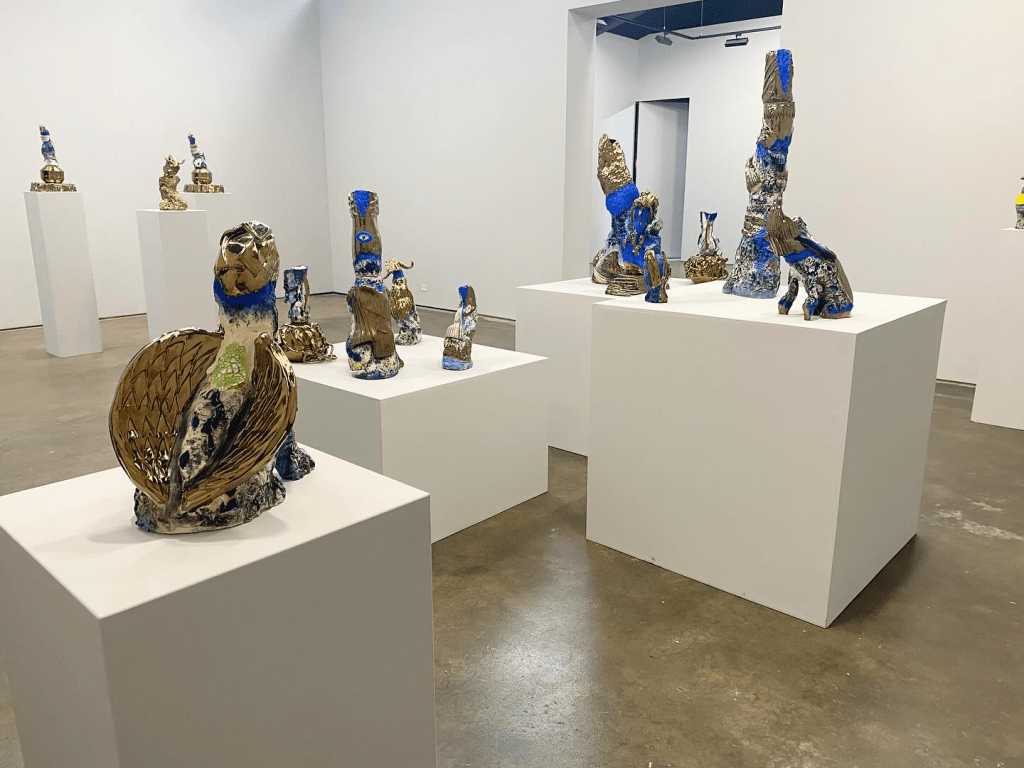
The setting for Ara Dolatian’s exhibition Heavenly Bodies does not do justice to his glittering, warped, ceramic idols. I don’t mind James Makin’s gallery, the polished concrete floors and anonymous art-gallery-white walls make sense to hang pastel toned, modernist domestica of Annalisa Ferraris, or to be dominated by the moody, storm-afflicted paintings of Paul Ryan, or the coarse, abstracted landscapes conjured out of blues and browns from Zoe Grey. But for Dolatian, I would prefer something more akin to the architectural drama of a cathedral, or at the very least a darkened room, tastefully painted black, perhaps with golden spotlights set to hit the works’ most mirrored edges — a ritual to desperately attempt invocation of the gods that sleep within those twisting vessels. To hell with white plinths.
Dolatian is doing his part for the drama — his piece She She (2023), a mutant figure of pure glazed gold, adorned with horns and a subtle, foot-position eye, sits first and foremost in contrast to its fellow entities, those of which are blushed with lapis-lazuli blues to break up their own golden details. One could begin to tease out a hierarchy of material purity from amongst his works: the lesser gods, the melting amphori, and the omnipotent golden master. But what power is commanded through gold is undermined by the sheer textural complexity of the approximate sculptures, each work truly owning its domain in its own right.
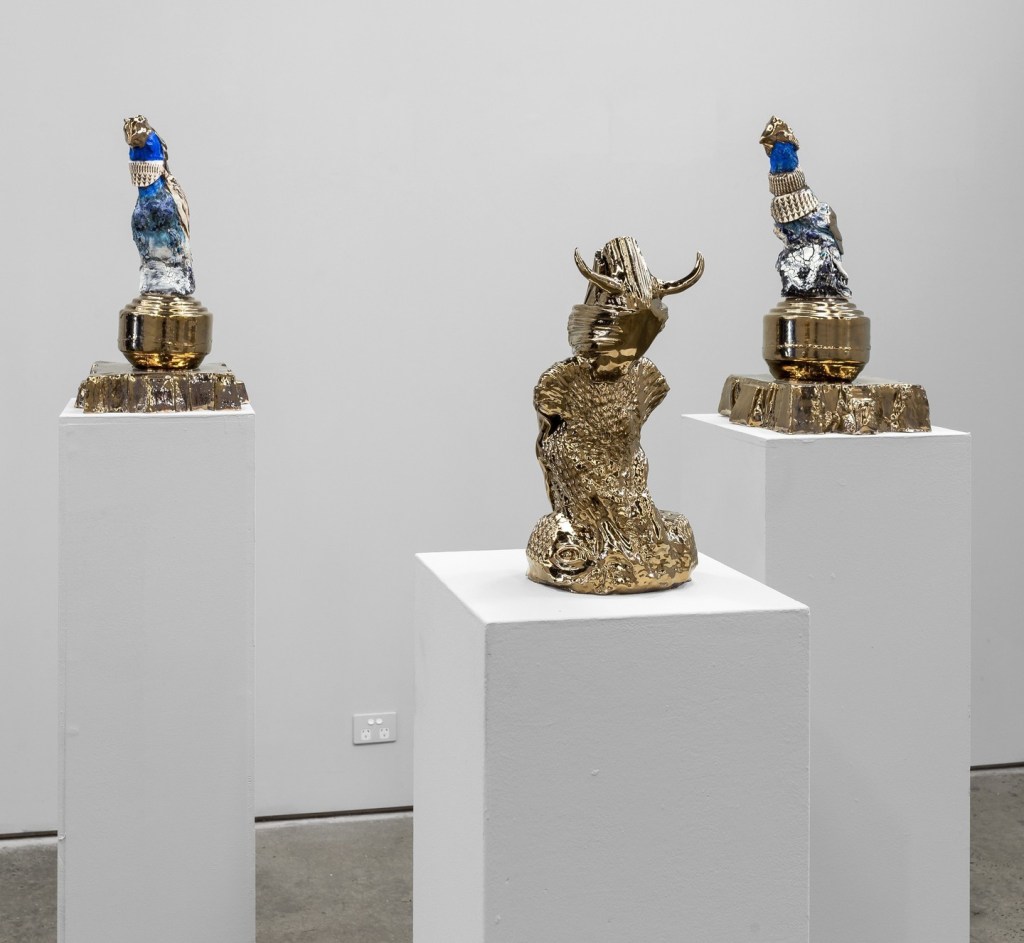
One cannot dismiss the awe-striking scale of works Aerial (2023) and Guide (2023), rising above their constituents nearly a meter into the air. Stunning too are the guardian beasts that sit in each corner, Su (2023), Kingdom (2023), Umma (2023), their presence indicative of an organised coalition of sculptures — not only are the works in dialogue with each other, their fluctuating relationships are clearly visible too. Some of my favourite works are Dolatian’s liquefying vessels, seated on tentacled beds of gold. They play well with his conceptual practice of transfiguring memories and histories: the works Treasure (2023) and Adore (2023) calling to mind a museum’s horde of delicate pots and stoneware containers — but are liberated from those confines, and elevated to psychedelic, divine heights. All shades of ocean-blue seep from the stone like melting irises. Handles have curdled into something appendage shaped, almost fin-like. Gold indicates the casual presence of a deity’s hand idly tracing the curves and edges. And the gold bulb of a seat on which they stand, a knot of roots with the subtle appearance of an alien creature. The white plinth remain insufficient; half-hearted in its attempt to hold the weight of the gods.
The history-soaked, opulent associations elicited by Dolatian’s work, is dulled by the coldness of the white-walled gallery setting. While there is argument for the notion of art to be shown on its own terms, this discounts the genuine affective power of space and environment. Sometimes a blank space is deadening, rather than clarifying. Perhaps it is the way I have felt myself slowly going insane in apartments of permanently fragile white walls, the insistence on domestic sterility (or really, a landlord’s anal paranoia). The insistence on neutrality renders that neutralness the complete opposite, it becomes a searing dirge. Celebrity homes on Architectural Digest showcase minimalism, clean walls, white furniture on polished floors, beige “highlights”. It is maddening. I want a gallery to transport me away from whatever predetermined, perma-clean antiseptic aesthetic I encounter over and over, I am desperate for an escape. When I encounter Dolatian’s work, I yearn for a nighttime-Parthenon, or shaded stoney atrium, perhaps even a garden, where there is some sense of controlled chaos to compliment the spirituality of those blue and gold sculptures. I want pleasure, and frequently, I find anemia.
Off in a side room to the James Makin Gallery is a small library space, with darkened walls, low waist level shelving for a collection of texts, and inviting sofa chairs. Here a few of Dolatian’s older works, still in his lapis-gold-deity style, sitting in contemplative hermitage. Here is where I found myself for most of my visit to this exhibition, as this was a setting that suddenly made sense for these works. Dark, contemplative, like stepping into a small, modest temple. Yet this was not the exhibition. More a complimentary afterthought. And yet in that small room, I saw a vision of Dolatian’s curatorial future, and the white-walled gallery was far, far away. Fingers crossed.
 grafik affects
Leave a comment